The Rede D'Or case: 16.5% less water in 40 hospitals, in a GRI report
In its 2025 sustainability report, prepared under GRI standards, Rede D'Or recorded the Water Efficiency Project carried out with T&D: 16.5% lower consumption, 260,000 m³ of water saved and 40 hospitals served. See what the report says, what was done in the hospitals and why a third party's record counts as proof.
By T&D Sustentável 5 min read
In this article · 7
Rede D’Or cut water consumption by 16.5% in the hospitals served by T&D Sustentável and saved 260,000 m³ of water in 2025. The result is in the network’s 2025 Integrated Sustainability Report, prepared under GRI standards, in which the Water Efficiency Project names T&D’s TDRR platform. In 2025, the project reached 40 hospitals.
In short:
- 16.5% lower water consumption and 260,000 m³ saved in 2025.
- 40 hospitals served, after 12 more units joined the project in 2025.
- The record is in the “Water and effluents” chapter of the Rede D’Or report, linked to GRI indicators 303-1 and 303-2.
- The project combines flow restrictors, leak hunting, remote tank monitoring with TDRR and plumbing maintenance with more efficient equipment.
- It is the strongest proof T&D has: the number is not T&D’s, it comes from the client’s own sustainability report.
What does the Rede D’Or report say about T&D?
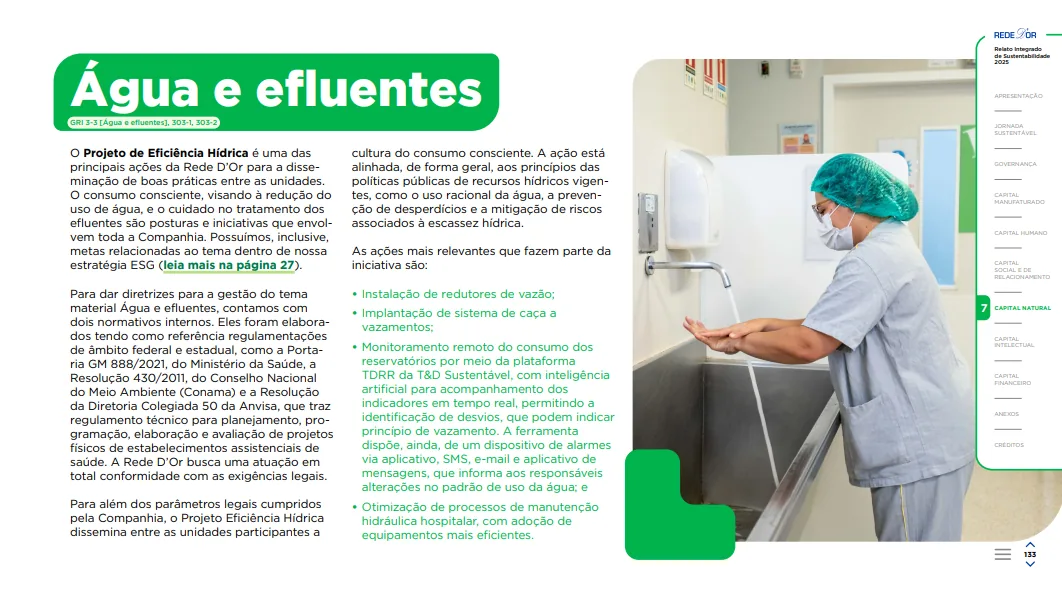
That T&D is part of the Water Efficiency Project, one of the network’s main initiatives to spread good practice among its units. On page 133 of the 2025 Integrated Sustainability Report, in the “Water and effluents” chapter, Rede D’Or describes the project, the internal standards that guide water management and the most relevant actions, and names T&D Sustentável’s TDRR platform.
The report also lists the references the network follows for water and effluent management in its hospitals, including Ministry of Health Ordinance GM No. 888/2021, CONAMA Resolution No. 430/2011, on effluent discharge, and Anvisa RDC No. 50, on the physical design of healthcare facilities.
What was done in the hospitals?
Four actions, according to the Rede D’Or report:
| Action | What it does |
|---|---|
| Flow restrictors | Reduce the water coming out of taps and showers without taking away their function |
| Leak hunting system | Finds leaks that cannot be seen with the naked eye |
| Remote monitoring with TDRR | Tracks tank consumption in real time, with artificial intelligence, and spots deviations that may signal the start of a leak |
| Hospital plumbing maintenance | Streamlines maintenance processes and adopts more efficient equipment |
According to the report, TDRR also has alarms by app, SMS, email and messaging app that tell those in charge about changes in water use patterns. So the maintenance team learns about a problem when it starts, not when the bill arrives.
What were the results in 2025?
| Indicator | Result in 2025 |
|---|---|
| Reduction in water consumption | 16.5% |
| Water saved | 260,000 m³ |
| Hospitals served | 40, with 12 new units in the year |
For scale: 260,000 m³ is 260 million litres. In his testimonial to T&D, Márcio Botelho, maintenance supervisor at Rede D’Or in Rio de Janeiro, said the monitoring and SEA brought operational gains to the hospital, flagging possible leaks and keeping water consumption under control.
Why is a result in a GRI report worth more?
Because T&D is not the one signing it. GRI is one of the most widely used sustainability reporting standards in the world, and its water standard (GRI 303) asks the company to disclose how water is used, withdrawn, discharged and consumed. When a client publishes the result in its own report, the client is the one reporting the number, under the governance of its report.
For anyone assessing a water efficiency project, this answers the question that matters most: does the result show up outside the sales presentation? At Rede D’Or, it does. The GRI water indicators and how to prove results are in ESG and water management.
How do you take the same method to another hospital?
By measuring before any replacement. The step by step, with the points that use the most water in a hospital, the per-bed indicators and the care around infection control, is in water management in hospitals.
TDRR monitors tanks, cisterns, pumps and consumption hour by hour and alerts by app, SMS, email and WhatsApp when something leaves the normal pattern; monitoring alone delivers an average 10% reduction in consumption, according to T&D’s data. SEA 360º handles implementation, without building works, with a baseline under the IPMVP protocol, efficiency technology at points of use, electronic leak detection and repairs, followed by ongoing management. The ceiling observed in the full programme is a 70% reduction in consumption.
Frequently asked questions
How much water did Rede D’Or save with T&D?
In 2025, 260,000 m³ of water, with a 16.5% reduction in consumption across the 40 hospitals served, according to Rede D’Or’s 2025 Integrated Sustainability Report, prepared under GRI standards.
What is the Rede D’Or Water Efficiency Project?
It is one of Rede D’Or’s main initiatives to spread good water practices among its units. It includes flow restrictors, leak hunting, remote tank monitoring with T&D’s TDRR platform and streamlined plumbing maintenance.
What does TDRR do in Rede D’Or hospitals?
It monitors tank consumption in real time, with artificial intelligence, spots deviations that may signal the start of a leak and alerts those in charge by app, SMS, email and messaging app when the use pattern changes.
How many Rede D’Or hospitals does T&D serve?
40 hospitals in 2025, after 12 more units joined the project that year.
Can the Rede D’Or result be checked?
The result is published in Rede D’Or’s own sustainability report, under GRI standards, not in T&D material. The client reports the number, in its water and effluents chapter.
Sources
- Rede D’Or, Relato Integrado de Sustentabilidade 2025 (2025 Integrated Sustainability Report), “Água e efluentes” chapter (GRI 3-3, 303-1 and 303-2), p. 133, in Portuguese: Water Efficiency Project, actions and mention of T&D Sustentável’s TDRR platform
- T&D Sustentável indicators: 16.5% reduction, 260,000 m³ and 40 hospitals, recorded in the Rede D’Or report
- Testimonial by Márcio Botelho, maintenance supervisor at Rede D’Or in Rio de Janeiro, published by T&D
- T&D TDRR and SEA 360º