Smart water meters: how they work, how to read them and what changes on the bill
A digital water meter records consumption electronically and, when it is smart, sends the reading on its own, hour by hour. See the types, how to read the dial, what changes on the bill and how a company can get remote readings without waiting for a new meter.
By T&D Sustentável 9 min read
In this article · 8
A digital water meter has an electronic register and a digital display, instead of the number wheels and pointers of the old model. A smart water meter goes further: besides measuring, it sends the reading on its own to the water utility or to a platform, usually every hour. In practice, consumption stops being a monthly surprise and a leak shows up within hours: in São Paulo, the utility Sabesp has started replacing 4.4 million meters with smart models, on a phased schedule running to 2029.
In short:
- A digital meter has an electronic register; a smart meter also transmits the reading on its own, over a network.
- The most common types are the mechanical meter with a remote-reading module, the ultrasonic meter, with no moving parts, and the electromagnetic meter, for large flows.
- Sabesp has started installing 4.4 million smart meters in São Paulo and São José dos Campos, through 2029, with consumption visible every hour in its app.
- The meter at the connection belongs to the water utility. To see hourly consumption by area, a company uses its own sub-meters or image-based reading of the meter it already has.
- The gain is in the alert: night-time consumption out of pattern is a leak, and whoever sees it right away does not wait for the bill.
What is a digital water meter, and what is a smart one?
The two names often appear together, but they describe different things. Digital is how consumption is recorded and displayed; smart is the ability to send the reading without anyone going to the meter.
| Analogue meter | Digital meter | Smart meter | |
|---|---|---|---|
| How it shows consumption | Number wheels and pointers | Electronic display | Electronic display and remote transmission |
| Who reads it | The meter reader, on site | The meter reader, on site | The meter itself, over the network |
| How often it is read | Once per billing cycle | Once per billing cycle | Hour by hour, depending on the system |
| When a leak shows up | On the bill | On the bill | Within hours, with an alert |
A digital meter without communication still depends on the meter reader. Transmission is what changes management: with hourly data, you can see each day’s consumption profile, compare nights and spot a loss before it becomes a bill.
How does a smart water meter work?
Every smart meter does two things: it measures the volume passing through and it transmits the result. Measurement can follow three principles:
| Type | How it measures | Where it is usually used |
|---|---|---|
| Mechanical with a remote-reading module | A turbine or piston turns as water flows, and a sensor converts the rotation into electrical pulses | Ordinary connections and metering by area in companies |
| Ultrasonic | Measures how long ultrasound pulses take to cross the water, with and against the flow, with no moving parts | New connections and telemetry projects |
| Electromagnetic | Water passing through a magnetic field generates a voltage proportional to its speed | Large flows, industry and network inlets |
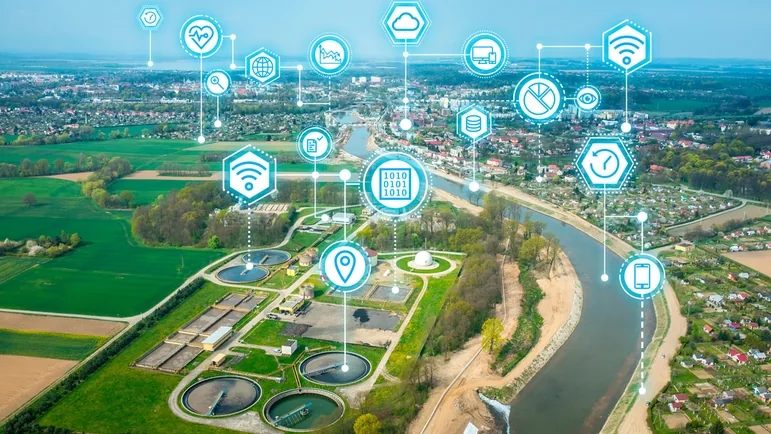
After measuring, the meter transmits: over an Internet of Things cellular network, as in Sabesp’s project, or over long-range radio networks. The reading reaches a platform that stores the history and triggers the alerts.
In Brazil, water meters follow the metrological regulation of Inmetro, the national metrology institute (Ordinance No. 155/2022), and the ABNT NBR 16043 standard. A communication module fitted later must not invalidate the model’s Inmetro approval, as the meter specification of DAE Jundiaí, a municipal utility, records.
How do you read a water meter?
The meter reading shows how much water has passed through it since it was installed. Consumption over a period is the difference between two readings.
- On an analogue meter, the black numbers show cubic metres, and the red numbers and pointers show fractions, in litres. For the bill, note only the black ones.
- On a digital meter, the display usually cycles through screens: the accumulated volume in m³, the current flow and the device’s warnings, such as reverse flow or battery. The sequence changes from one model to another, and the manufacturer’s manual explains each screen.
- To work out consumption, note the reading on the same day and time, a week or a month apart, and subtract. Each cubic metre is 1,000 litres.
- To check the bill, compare your reading with the current reading on the invoice. The lines of the bill are explained in how to read a company water bill.
The meter is also the simplest leak test: with everything shut, it should not move. The step by step is in hidden water leak: 7 signs and the 1-hour test.
What changes on the bill with a smart meter?
The tariff does not change: the price per cubic metre is the same. What changes is the information, and three things improve:
- An actual reading every month. Without depending on the meter reader’s access, the estimated reading by average comes to an end, along with the high adjustment it usually brings the following month.
- Consumption in plain sight. In Sabesp’s project, customers follow their consumption every hour and for the previous day in the utility’s app.
- Leaks before the bill. According to Sabesp, the new meters will be able to detect possible leaks before the bill closes, because consumption out of pattern shows in the hourly history.
The replacement of the connection meter is done by the water utility, on its own schedule and under its own rules. In São Paulo and São José dos Campos, Sabesp is installing the new meters in phases through 2029; in São José dos Campos, the target is digital metering in every property in 2026.
How can a company get a smart water meter?
The meter at the connection belongs to the water utility and measures the whole connection. For a company, which needs to know where water goes and react quickly, there are three paths, and they can be combined:
| Path | What it measures | How often | What it requires |
|---|---|---|---|
| The utility’s smart meter | The whole connection | Hour by hour, in the utility’s app | Waiting for the replacement in your city |
| Own meters by area, with telemetry | Each area: kitchen, laundry, cooling tower, buildings, irrigation | Hour by hour, with alerts | Installing meters after the utility’s meter |
| Image-based reading of the existing meter | The meter already installed | Daily or more often, with alerts | A camera or a photo, without replacing the meter |
The second path is where TDRR, T&D’s remote monitoring, comes in: hourly, night-time, daily and monthly consumption, tank and cistern levels and pump failures, with alerts by app, SMS, email and WhatsApp. Monitoring alone delivers an average 10% cut in consumption, according to T&D, mostly from finding leaks and faults early. In the third, TD Edge and FluvieX read the meter by image, with artificial intelligence: with TD Edge, a member of staff sends the photo; with FluvieX, a device captures and sends the reading on its own. Both produce daily reports and alerts for consumption out of pattern.
Before fitting any equipment to the connection meter, talk to the water utility: the meter is theirs. Your own meters, installed after it, are managed by the company.
Is a smart water meter worth it?
For the utility, the replacement is a whole-network project. For a company, the question is different: how much does it cost to discover a leak only on the bill? A toilet with a visible trickle loses 144 litres a day, according to the water conservation manual of Brazil’s National Water Agency (ANA), FIESP and SindusCon-SP, and a buried pipe leaks all day long. Hourly metering shortens that time from weeks to hours.
The gain is greatest where there are many points of use, 24-hour operations, tanks and pumps, or a history of bills that swing for no reason: hospitals, hotels, shopping centres, schools, factories and residential buildings. How telemetry works day to day, with alerts and a response routine, is in remote water consumption monitoring.
Frequently asked questions
Is a digital water meter more accurate than an analogue one?
Every water meter sold in Brazil must meet Inmetro’s metrological regulation. The advantage of the ultrasonic meter is that it has no moving parts that wear with use, which helps keep the measurement stable over time. The mechanical meter remains reliable within the utility’s replacement period.
Who replaces the meter with a smart model?
The water utility, on its own schedule, because the connection meter is its responsibility. In São Paulo and São José dos Campos, Sabesp is doing the replacement in phases through 2029.
Does a smart water meter detect leaks?
It detects the sign of a leak: consumption out of pattern, especially at night, which triggers an alert. It does not show where the water is escaping. To find the spot without breaking walls, leak detection comes in, with geophone surveys, thermography and pressure tests.
Can I install a smart water meter myself?
Yes, after the utility’s meter, as your own meter for an area or for the whole property. The bill is still calculated from the utility’s meter; yours serves management, alerts and checking the invoice.
How do you see the consumption of a Sabesp smart meter?
In the utility’s app, where customers with the new meter can follow consumption every hour and for the previous day, according to Sabesp.
Sources
- Mobile Time, report on Sabesp’s Internet of Things water meters (11/02/2026), in Portuguese: 4.4 million meters, cities, schedule to 2029, hourly consumption in the app and leak detection
- DAE Jundiaí, technical specification ETM-031 for water meters (2026), in Portuguese: Inmetro Ordinance No. 155/2022 and communication modules
- Conservação e reúso da água em edificações (ANA, FIESP and SindusCon-SP, 2005), leak loss table, reproduced in Souza et al., 21st Brazilian Water Resources Symposium (ABRHidro, 2015), in Portuguese
- TDRR, T&D remote monitoring: an average 10% cut in consumption from monitoring alone
- TD Edge and FluvieX, image-based meter reading