Remote water monitoring: how telemetry finds the leak before the bill does
Remote monitoring reads water consumption, tank levels and pumps hour by hour and warns when something leaves the usual pattern. See how telemetry works, what to watch, how it finds the leak before the bill and how to roll it out in a company.
By T&D Sustentável 8 min read
In this article · 8
Remote water consumption monitoring is the automatic reading of meters, tank levels and pump operation, hour by hour, with the data sent by telemetry to a platform that warns when something leaves the usual pattern. It does not save water on its own: it shortens the time between the problem and the response. A leak that would take a billing cycle to show up becomes an alert the same night.
In short:
- Water telemetry means measure, transmit and alert: sensors at the points of use, automatic data transmission and a warning to whoever needs to act.
- What is worth watching: hourly and night-time consumption, tank and cistern levels and pump starts and failures.
- The strongest sign of a leak is night-time consumption with operations stopped.
- From monitoring alone, the average reduction observed by T&D is about 10%, mostly from finding leaks and faults early.
- Rolling it out requires no construction works: sensors on the meters and tanks, its own communication link and alert rules with a named owner.
How does remote water monitoring work?
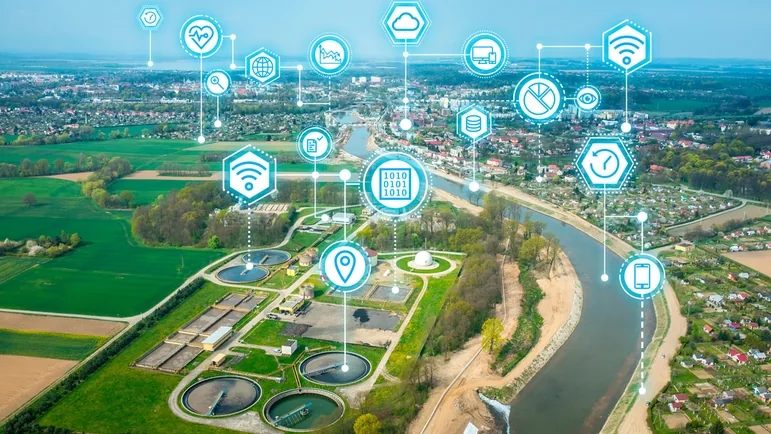
The system has four layers, and each one can fail on its own. That is why it is worth knowing all of them:
| Layer | What it does | Examples |
|---|---|---|
| Measurement | Turns consumption, level and operation into data | Meter with pulse output, ultrasonic meter, image-based meter reading, tank level sensor, pump signal |
| Transmission | Takes the data from the site to the cloud | Internet of Things cellular network, long-range radio, local network |
| Platform | Stores the history and shows the charts | Consumption by hour, day and month, point by point, with reports |
| Alert | Warns whoever needs to act | App, SMS, email and WhatsApp |
Measurement does not require replacing everything. Many meters accept a sensor that turns rotation into pulses; others are read by image, without touching the device. The meter types and how they differ are covered in smart water meters.
What can you monitor?
Four groups of data account for most of an operation’s problems:
- Hourly, daily and monthly consumption. It shows each point’s profile: when operations start, the daily peaks and what changes at the weekend.
- Night-time consumption. With operations stopped, what remains is loss or equipment running out of hours.
- Tank and cistern levels. They warn before a shortage and reveal a float valve that does not close, when water keeps flowing in with the tank full.
- Pump starts and failures. A pump that keeps switching on and off usually points to a loss in the network; a stopped pump is a supply risk.
In regions with intermittent supply, the tank level also shows the right moment to call a water tanker, before a shortage stops operations.
How does telemetry find the leak before the bill?
Every point of use has a pattern: the curve of a weekday, of a Saturday, of a night. A leak changes that pattern in a characteristic way, because it never stops. It adds constant consumption around the clock, and it is at night, when everything else nearly drops to zero, that it shows up clearly.
| Sign on the dashboard | What it usually is | What to do |
|---|---|---|
| Night-time consumption above normal | A leak or equipment running out of hours | Walk-round and test by area, closing valves |
| Tank losing level with operations stopped | A leak after the tank | Isolate sections and watch the level |
| Pump switching on and off non-stop | A loss in the pressurised network or a float valve problem | Check the float valve and test the network |
| Water flowing in with the tank full | A float valve that does not close and an overflow running | Adjust or replace the float valve |
| Isolated peak during working hours | Washing or a process outside the procedure | Check the area’s routine |
The alert shows that there is a loss and where in the system it started. The exact location of the leak, inside a wall or under a floor, is the job of leak detection, which locates it with geophone surveys, thermography and pressure tests, without breaking walls. The search step by step is in hidden water leak: 7 signs and how to find it.
It is the same logic as the smart meters that Sabesp has started installing in São Paulo: with hourly consumption, possible leaks show up before the bill closes.
How much does remote monitoring cut consumption?
With TDRR, T&D’s remote monitoring, the average reduction observed is about 10%, mostly from identifying leaks and operational faults early. It is the floor of what data delivers on its own, before any equipment replacement or process change.
The rest of the reduction comes from what is done with the information. In the full SEA 360º programme, which combines monitoring, leak detection, standardised points of use and ongoing management, the reduction observed by T&D reaches up to 70%. At Rede D’Or, T&D’s water efficiency project cut consumption by 16.5% across the 40 hospitals served, according to the network’s sustainability report, prepared under the GRI standard. The case is in the Rede D’Or case: 16.5% less water in 40 hospitals.
How do you roll out remote monitoring in a company?
In seven steps, from the map to the routine:
- Map the points. The main inlet, the areas that consume most, the tanks and cisterns and the pumps. Start with what weighs most and what worries most.
- Choose how to measure each point. A pulse sensor on the meter, image-based reading or a level sensor, depending on the point. In most cases, with no works and without stopping operations.
- Define the communication link. Transmission over a cellular network does not depend on the company’s internal network and works in plant rooms and basements, wherever there is signal.
- Learn what normal looks like. The first weeks of data show each point’s profile: weekdays, weekends, nights.
- Set up the alerts. Time-based limits for consumption, a minimum level for the tanks, a maximum running time for the pump.
- Give every alert an owner. Who receives it, how quickly they check and what they do. An alert without an owner becomes noise.
- Review every month. The report shows the losses avoided, the alerts that repeat and the limits that need adjusting.
With TDRR, implementation requires no construction works, alerts arrive by app, SMS, email and WhatsApp, and T&D analysts watch the dashboard 24 hours a day. The data can be exported and consumed by other management systems. For the full programme, from monitoring to target, see the guide to water savings for businesses.
Remote monitoring or manual reading?
Manual meter reading is still useful, especially to get started. What monitoring changes is the speed:
| Manual reading | Remote monitoring | |
|---|---|---|
| Frequency | Weekly or monthly | Hour by hour |
| Night-time leak | Invisible until the next reading | Alert the same night |
| Tanks and pumps | On-site walk-round | Level and failures on the dashboard |
| History | Spreadsheet filled in by hand | Charts by point, exportable |
| Depends on | Someone remembering to read | The sensor and the alert rule |
Frequently asked questions
What is water telemetry?
It is measurement at a distance: sensors read consumption, level or equipment operation and transmit the data automatically to a platform. Telemetry replaces on-site reading and lets you follow consumption hour by hour, with alerts.
Do you need to replace the water meter to get remote monitoring?
Not always. Many meters accept a pulse sensor, and the meter can also be read by image, without replacing the device. Replacement is only needed when the existing meter allows neither of the two.
Does monitoring work without internet on site?
Systems that transmit over an Internet of Things cellular network do not depend on the company’s internal network. What matters is having a mobile signal at the installation point, such as the plant room or the basement.
Who receives the alerts?
Whoever the company decides: maintenance, facilities, site management. With TDRR, alerts arrive by app, SMS, email and WhatsApp, and T&D analysts watch the dashboard 24 hours a day.
Can the data be integrated with other systems?
Yes. With TDRR, the data can be exported and consumed by other management systems, such as maintenance and facilities tools.
Sources
- TDRR, T&D remote monitoring: what is monitored, alerts, 24-hour analysts and an average 10% cut in consumption from monitoring alone
- Mobile Time, report on Sabesp’s Internet of Things water meters (11/02/2026), in Portuguese: hourly consumption and leak detection before the bill closes
- The Rede D’Or case: 16.5% less water in 40 hospitals, with figures from the network’s sustainability report (GRI standard, 2025)