Saving water in a residential building: 10 measures and ready-to-use notices
In a residential building, water is lost in common areas, in tanks and in leaks that shared billing hides. See 10 measures for the building manager, from the supply pipe test to individual metering, and water-saving notice templates ready to put on the noticeboard.
By T&D Sustentável 10 min read
In this article · 6
To save water in a residential building, start with what belongs to the building: leaks in the shared pipework, in the tanks and in common areas, which run around the clock and go on everyone’s bill. Then adjust what uses water in the common areas, meter each unit’s consumption and agree the rules with residents, with clear notices. Below are the 10 measures, in the order that usually delivers results fastest, and notice templates ready to use.
In short:
- Shared billing hides waste: whoever saves splits the bill with whoever wastes, and one unit’s leak disappears into the building’s total.
- The supply pipe test, with the tank inlet closed, shows whether there is a leak between the meter and the cistern.
- In common areas, the hose is the biggest avoidable use: 15 minutes of hosing a floor takes 279 litres, according to a São Paulo state government leaflet.
- A medium-sized uncovered pool loses about 3,785 litres a month from evaporation alone; with a cover, 90% less.
- Short, specific notices, with a concrete request and a contact, are the ones residents read; the templates below can be copied and adapted.
Where does a residential building use the most water?
The building’s bill adds up five sources, and each gives a different signal:
| Where | What happens | Signal |
|---|---|---|
| Shared pipework and risers | Hidden leaks in walls, slabs and car parks | Total consumption that rises and stays up |
| Tanks and pumps | A float valve that does not close, an overflow running, a pump switching on non-stop | Overflow dripping, pump working at night |
| Common areas | Washing the car park and pavement with a hose, gardens, pool | Peaks on cleaning and watering days |
| Units | Leaking toilets and taps, usage habits | Invisible while billing is shared |
| Metering | Only the main meter, read once a month | The bill rises and nobody knows where |
Which measures save water in a residential building?
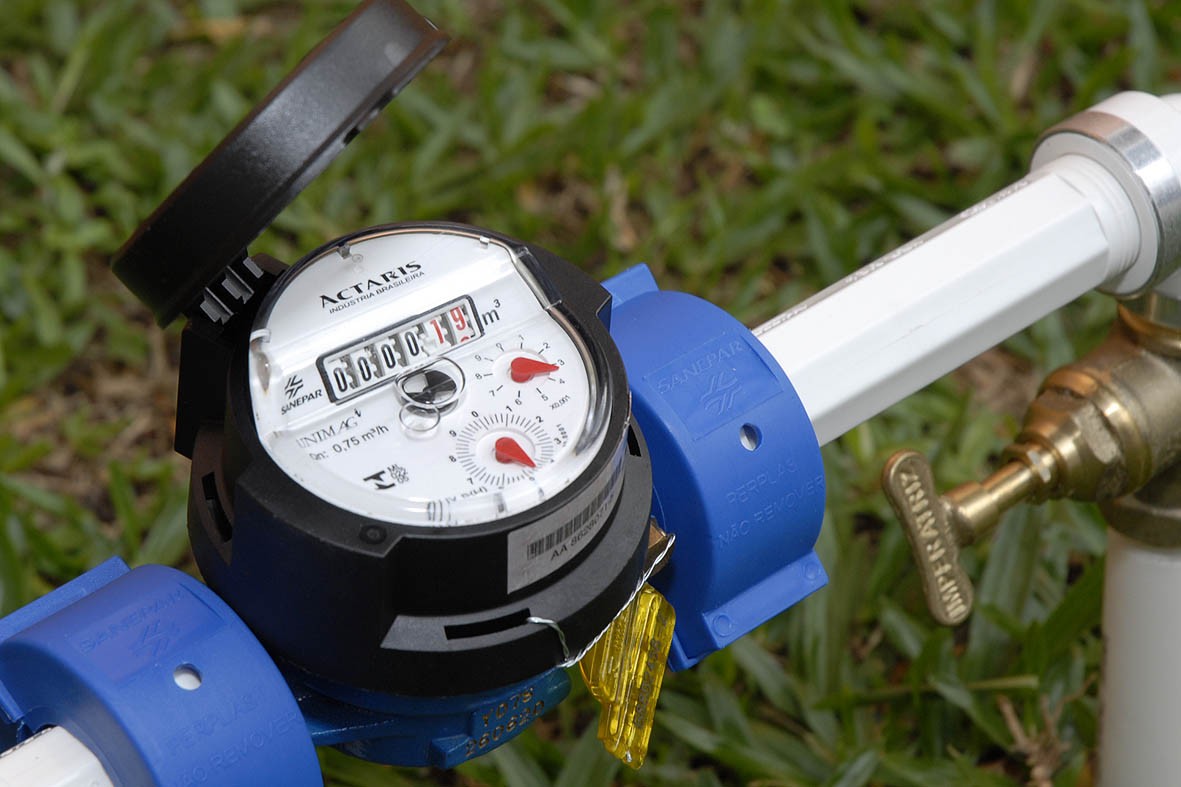
1. Read the main meter every week
On the same day and time, in a simple spreadsheet, with the daily average. The jump shows up weeks before the bill, and month-to-month comparison stops being a debate.
2. Test the supply pipe and watch the night
In a building, the flats are supplied from the tanks. Close the inlet valve of the cistern or lower tank and watch the main meter: if it keeps turning, there is a leak between the meter and the tank, almost always in a buried pipe. For leaks after the tanks, follow consumption during the quietest night hours over several weeks: it is not zero in a residential building, but it is stable, and a jump that does not come back points to a loss.
3. Check float valves, overflows and pumps
An overflow dripping is treated water going straight down the drain. A pump that keeps switching on and off usually points to a leak in the pressurised network or a badly set float valve. Include all three in maintenance’s weekly round.
4. Broom and bucket for cleaning
Hosing a floor for 15 minutes takes 279 litres, according to a São Paulo state government leaflet. The car park, pavement and halls can be cleaned with a broom, squeegee and bucket, and stains with a damp cloth. Agree the procedure with the cleaning team and the caretaker.
5. Water at the right time and cover the pool
An open hose can use up to 190 litres in 10 minutes, and under strong sun part of the water evaporates before reaching the roots: water early in the morning or late in the afternoon. A medium-sized pool exposed to sun and wind loses about 3,785 litres a month from evaporation alone; with a cover, the loss falls by 90%.
6. Aerators and adjusted valves in common areas
Party room, gym, changing rooms and staff washrooms: aerators on taps, adjusted flush valves and self-closing taps at the most used points.
7. A leak campaign in the units
A toilet with a constant trickle loses 144 litres a day, according to the water conservation manual of Brazil’s National Water Agency (ANA), FIESP and SindusCon-SP. Ask residents to do the dye test on the close-coupled cistern: a few drops inside the cistern, 15 minutes without flushing; if the colour shows in the bowl, there is a leak. The notice template is below.
8. Check the bill: billing units and category
The number of registered billing units (the units served by the connection) changes the minimum charge and the band consumption falls into. With fewer billing units than reality, consumption piles into the most expensive bands; with more, the added-up minimum exceeds real consumption. The lines of the bill are in how to read a company water bill, and the classification is reviewed by Water tariff consulting.
9. Introduce individual metering
With one meter per unit, each pays for what it consumes, and a leak shows up in the right flat. Individual metering has been mandatory in new buildings in Brazil since July 2021 and is possible in older ones. The step by step is in individual water metering in buildings.
10. Monitor the tank and consumption remotely
Sensors on the main meter and the tank show hourly consumption, the tank level and pump operation, with an alert when something leaves the usual pattern. That is what T&D’s TDRR does, with an average 10% cut in consumption from monitoring alone. See how remote water consumption monitoring works.
How do you write a water-saving notice for a residential building?
Keep notices short, with a concrete request, a deadline and a contact. The four notice templates below cover the most common situations: copy them, replace the fields in square brackets and put them up in the lift, on the noticeboard and in the building’s messaging group.
Template 1: general water-saving notice
Saving water: we are counting on you
Dear residents,
The building’s water bill is shared by everyone. To bring it down, we ask for three things:
- Tell the management if you notice a leak, the sound of running water or an overflow dripping: [phone or email].
- Check your toilet: a constant trickle into the bowl can waste 144 litres a day.
- Avoid washing balconies and cars with a hose: a bucket does the job with far less water.
Thank you, [Name of the building manager or management]
Template 2: toilet leak test
Leak test: please do it at home by [date]
Dear residents,
The building’s water consumption has risen in recent weeks, and we want to rule out leaks in the flats. The test takes 15 minutes:
- Put a few drops of food colouring inside the toilet cistern, not in the bowl.
- Wait 15 minutes without flushing.
- If the colour shows in the bowl, the seal is leaking. Call a plumber or tell the management: [contact].
Thank you for your help, [Name of the building manager or management]
Template 3: drought or supply rationing
Reduced supply: let us make the tank last
Dear residents,
According to [water utility], supply in the area will be [reduced or rationed] from [date] to [date]. Until then, the water available is what is in the building’s tanks. We ask for:
- short showers and the tap off while brushing teeth and soaping dishes;
- washing machines only with full loads;
- no hoses on balconies, cars or common areas.
We are watching the tank levels and will let you know of any change. [Name of the building manager or management]
Template 4: supply interruption for tank maintenance
Supply interruption: [date], from [time] to [time]
Dear residents,
For cleaning and maintenance of the tanks, the building’s supply will be interrupted on [date], from [time] to [time]. We recommend storing water for the period and keeping taps closed during the interruption, to avoid air in the pipes when the water returns.
Questions: [contact]. [Name of the building manager or management]
How do you get residents involved in saving water?
The notice opens the conversation; what keeps the result is feedback:
- Show the number. A simple chart on the noticeboard, with the building’s consumption month by month, makes everyone’s effort visible.
- Agree a collective target at the owners’ meeting, with a deadline, and share the result.
- Make reporting a leak easy, with a single channel and a quick response from maintenance.
- Include the staff: the caretaker and the cleaning and gardening teams follow the written procedure.
- Bring data to the owners’ meeting: decisions such as individual metering or remote monitoring are easier with the consumption history on the table.
Frequently asked questions
How do you write a water-saving notice for a building?
With a direct title, a concrete request, a deadline and a contact. Short notices are the ones residents read to the end. The four templates in this article cover general savings, a leak test, drought and an interruption for maintenance, and can be adapted with your building’s details.
How do you know whether the building has a leak?
Run the supply pipe test, closing the tank inlet and watching the main meter, and follow night-time consumption over several weeks. If the building has individual metering, compare total consumption with the sum of the units: a difference that grows for no reason points to a leak in the shared network.
Who pays for a leak inside a flat?
As a rule, pipework serving only one unit is the owner’s responsibility, and the risers and shared pipework belong to the building. The building’s bylaws and internal rules may set out the division in detail, and it is worth checking them before deciding.
Is individual metering worth it for a building?
For new buildings in Brazil, individual metering is already mandatory. In older ones, it pays off when the survey of the risers shows feasible works: each unit starts paying for what it consumes, and leaks show up in the right place.
How do you save water when cleaning the building?
Replace the hose with a broom, squeegee and bucket, use a damp cloth on stains and agree a written procedure with the team. Fifteen minutes of hose on a floor takes 279 litres. Rainwater, where it is harvested, can wash the car park and outdoor areas.
Sources
- Water-saving leaflet by SAAE Cordeirópolis, with São Paulo state government data, published by the PCJ basin committees (2014), in Portuguese: floor washing and pools
- São Paulo City Council, «Sabesp alerta para aumento do consumo de água com o calor» (2012), in Portuguese: garden hoses
- Conservação e reúso da água em edificações (ANA, FIESP and SindusCon-SP, 2005), leak loss table, reproduced in Souza et al., 21st Brazilian Water Resources Symposium (ABRHidro, 2015), in Portuguese
- Law No. 13,312 of 12 July 2016, in Portuguese: individual metering in new condominium buildings
- TDRR, T&D remote monitoring: an average 10% cut in consumption from monitoring alone