Water waste: the 4 hidden culprits nobody sees and how to stop them
Brazil lost 39.53% of its treated water in distribution in 2024, and inside companies the waste continues through four culprits that do not show to the naked eye: hidden leaks, unadjusted equipment, uncontrolled processes and lack of metering. See how much each one uses, where it hides in each sector and how to cut it.
By T&D Sustentável 10 min read
In this article · 6
Water waste is any treated water lost without being used: in the public network, which lost 39.53% of what it distributed in Brazil in 2024, and inside buildings, where the consumer pays for the loss. In a company it comes from four culprits that do not show to the naked eye: hidden leaks, unadjusted equipment, uncontrolled processes and lack of metering. Ending each one starts with measuring.
In short:
- Brazil lost 39.53% of its treated water in distribution in 2024, about 4.4 billion m³, according to Instituto Trata Brasil. That loss belongs to the utility’s network.
- Inside a company, waste comes from 4 culprits: hidden leaks, unadjusted equipment, uncontrolled processes and lack of metering.
- One by one the numbers look small; added up, they weigh. A toilet with a trickle loses 144 litres a day, and 15 minutes of hose on a floor, 279 litres.
- Each sector has its weak spot: floor washing in supermarkets, laundry in hotels, washrooms and drinking fountains in schools, cooling towers in industry.
- Cutting it starts with metering: without it, waste only shows on the invoice, a month later.
How much water does Brazil waste?
A lot, and before it even reaches the taps. The 2026 Water Loss Study, by Instituto Trata Brasil with GO Associados, built on SINISA data for 2024, shows the country lost 39.53% of its treated water in distribution. Physical losses alone, the water leaking from the networks, came to about 4.4 billion m³ in the year: enough to supply roughly 77 million Brazilians for a year, or the equivalent of 4,800 Olympic pools wasted every day.
Ordinance No. 788/2024 of Brazil’s Ministry of Cities sets loss limits for municipalities that receive federal funds. The country has already passed the first one:
| Reference | Loss in distribution |
|---|---|
| Brazil in 2024 (SINISA) | 39.53% |
| Limit until 2025 | 35% |
| Limit from 2026 to 2032 | 30% |
| Limit from 2033 | 25% |
According to the same study, only 12 of the 100 most populous municipalities already meet the target that applies from 2033.
That loss happens before the water meter, in the utility’s network, and does not reach anyone’s bill directly. The waste a company pays for happens after the meter, inside its own buildings. That is the subject of the rest of this article.
What are the 4 culprits of water waste in a company?
None of them makes noise. All of them show on the invoice.
| Culprit | How it shows | How much it can use | How to cut it |
|---|---|---|---|
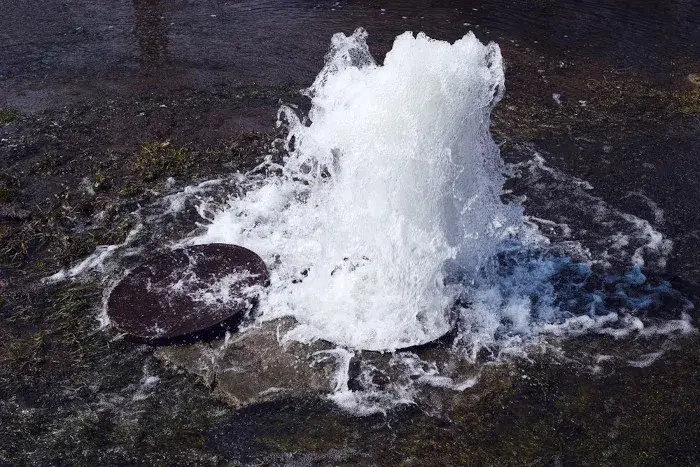
| Hidden leak | Consumption that rises and stays up; meter turning with everything shut | 144 litres a day from a single toilet with a trickle; a buried pipe leaks 24 hours | Meter test, night-time consumption and leak detection |
| Unadjusted equipment | Long flushes, high-flow taps and showers, urinals running | 10 to 14 litres per 6-second press of a flush valve | Adjust valves, aerators, timers and a pressure-reducing valve |
| Uncontrolled process | An open hose for cleaning, dishes under running water, watering in the sun | 279 litres in 15 minutes of hose on a floor | Written procedures, broom and squeegee, watering schedules, reuse |
| Lack of metering | One meter for the whole building; nobody looks at consumption until the bill arrives | Everything the other three use until somebody notices | Weekly readings, metering by area and telemetry with alerts |
1. Hidden leaks
The most expensive culprit, because it never stops. Water escapes inside walls, under floors, along a buried pipe or through the tank’s float valve, and passes through the meter as if it were consumption. The manual Conservação e reúso da água em edificações, by ANA with FIESP and SindusCon-SP, estimates 144 litres a day for a toilet with a visible trickle and from 6 to more than 32 litres a day for a dripping tap. A buried pipe has no table: it leaks all day, at mains pressure.
The signs, the one-hour test and how to find the spot without breaking walls are in hidden water leak: 7 signs and how to find it.
2. Unadjusted equipment
A flush valve pressed for 6 seconds uses 10 to 14 litres, according to a São Paulo state government leaflet. If the valve is badly adjusted, every press uses more, hundreds of times a day in a commercial building. The same goes for taps without aerators, high-flow showers in gyms and changing rooms, and urinals that run non-stop.
The fix is cheap and does not depend on anyone remembering anything: adjust the valves, fit aerators and flow regulators, use taps with timers or sensors in high-traffic washrooms and, where the mains arrive strong, a pressure-reducing valve.
3. Uncontrolled processes
This is water that runs while the team does something else. Washing a floor with a hose for 15 minutes takes 279 litres; washing dishes with the tap half open for the same time, 117; a garden hose can use up to 190 litres in 10 minutes. In a company, these habits become cleaning, kitchen and maintenance routines, repeated every day.
The way out is to write the procedure and train whoever carries it out: broom, squeegee and floor scrubber instead of the hose, dishes scraped before washing, watering outside sunny hours, machines always fully loaded. Where a process needs a lot of water, such as washing outdoor areas, flushing toilets and cooling towers, reuse water replaces drinking water. See how in water reuse in industry.
4. Lack of metering
The culprit that protects the other three. With a single meter for the whole building and nobody reading it, the night-time leak, the badly adjusted valve and the forgotten hose only show on the invoice, weeks later, mixed into one number.
Metering changes that. A weekly meter reading shows the jump before the bill; metering by area says where it is; telemetry warns right away. T&D’s TDRR watches tanks, pumps and consumption 24 hours a day, sends alerts by app, SMS, email and WhatsApp and delivers an average 10% cut in consumption from monitoring alone, mostly from finding leaks and faults early.
Where does waste hide in each sector?
The four culprits appear in every company, but each sector has the place where they hide best:
| Sector | Where water escapes | Where to start |
|---|---|---|
| Supermarkets | Floor washing, butcher, fish and produce counters, equipment cleaning | Cleaning procedure and metering by area. Supermarket tips |
| Hotels | Laundry, guest bathrooms, pool and gardens | Full loads in the laundry and regulated flow in the rooms. Water savings in hotels |
| Schools and universities | Shared washrooms and drinking fountains, hoses, kitchens and labs | Leaks in washrooms and campaigns with students. Waste in schools |
| Hospitals | Laundry, bathing, kitchens, cooling towers | Metering by building and ongoing maintenance. Water management in hospitals |
| Shopping centres | High-traffic washrooms, food courts, air conditioning with cooling towers | Sensor taps and cooling tower control. Savings in shopping centres |
| Restaurants | Pre-rinsing dishes, dishwashers, food preparation | Dry scraping first and full dishwasher loads. Savings in restaurants |
| Industry | Cooling towers, equipment washing, process water | Metering by line and reuse. Water reuse in industry |
| Residential buildings | Common areas, leaks in risers, consumption without shared billing | Meter test and individual metering. Saving water in a residential building |
How do you end water waste in a company?
In the order that delivers fastest, with what each step brings:
- Build the baseline. Gather the last 12 months of invoices and work out consumption per day and per unit of the operation: per bed, per meal, per student, per guest. Without that number, you cannot say whether the savings happened.
- Hunt and fix leaks. The meter test, night-time consumption and, where the network is buried or old, a search with equipment. This step pays most at the start.
- Adjust and replace equipment. Flush valves, aerators, flow regulators, timers and a pressure-reducing valve. They work on their own, without depending on habit.
- Rewrite processes and involve the team. Cleaning, kitchen and watering procedures; reminders at the points of use; a simple channel for anyone to report a leak; targets by area, with the result shown to those who helped reach it.
- Keep measuring. Weekly readings, metering by area and automatic alerts. That is what stops waste from coming back.
These steps are the backbone of T&D’s SEA 360º: the implementation, which requires no construction works, covers electronic leak detection, efficiency technology, standardised fittings and staff training; ongoing management covers monitoring, maintenance and monthly reports, with savings measured under the IPMVP protocol. In the full programme, the reduction observed by T&D reaches up to 70%. At Rede D’Or, T&D’s water efficiency project cut consumption by 16.5% across the 40 hospitals served, saving 260,000 m³ in 2025, according to the network’s sustainability report, prepared under the GRI standard.
For the whole programme, from assessment to target, see the guide to water savings for businesses. And if the bill stays high even without waste, the problem may be in the billing: see my water bill went up: causes and how to cut it.
Frequently asked questions
What is water waste?
It is any treated water lost without being used: leaks, use beyond what is needed and water escaping from the networks before reaching the consumer. In a company, it shows up as hidden leaks, unadjusted equipment, uncontrolled processes and lack of metering.
What is the difference between water loss and water waste?
Loss is the technical name for water the supply system cannot deliver or bill, because of leaks in the networks, metering errors or irregular connections. Waste is use beyond what is needed and the leak after the meter, inside the property. The first weighs on the utility; the second, on the bill of whoever consumes.
How much water does Brazil waste?
In 2024, the country lost 39.53% of its treated water in distribution, according to Instituto Trata Brasil, using SINISA data. Physical losses alone came to about 4.4 billion m³, enough to supply roughly 77 million Brazilians for a year.
How do you get employees involved in saving water?
With information close to the point of use, targets by area and feedback on results. Reminders by sinks and toilets, an easy channel to report leaks and month-by-month consumption figures let the team see the effect of what changes. Adjusted equipment helps, because it saves even when someone forgets.
Why doesn’t the bill go down even when we save water?
Three reasons are common: a hidden leak that cancels the savings, a tariff increase in the same period, or billing with the wrong classification, such as the wrong category or number of billing units. Always compare consumption in m³, not the amount, and check the classification with Water tariff consulting.
Sources
- Water Loss Study 2026 (SINISA, 2024), Instituto Trata Brasil and GO Associados, in Portuguese: losses in distribution, volume, equivalences and municipalities meeting the target
- Ordinance No. 788 of 1 August 2024, Brazil’s Ministry of Cities: loss limits in distribution, quoted in the Instituto Trata Brasil study
- Conservação e reúso da água em edificações (ANA, FIESP and SindusCon-SP, 2005), leak loss table, reproduced in Souza et al., 21st Brazilian Water Resources Symposium (ABRHidro, 2015), in Portuguese
- Water-saving leaflet by SAAE Cordeirópolis, with São Paulo state government data, published by the PCJ basin committees (2014), in Portuguese: flush valves, floors and dishes
- São Paulo City Council, «Sabesp alerta para aumento do consumo de água com o calor» (2012), in Portuguese: garden hoses
- TDRR, T&D remote monitoring: an average 10% cut in consumption from monitoring alone
- The Rede D’Or case: 16.5% less water in 40 hospitals, with figures from the network’s sustainability report (GRI standard, 2025)