Water crisis in Brazil: what caused 2014 and 2021 and why it can return
A water crisis is when the water available cannot meet the uses that depend on it. See what happened in 2014, when the Cantareira System received a quarter of a normal year's water, and in 2021, when Brazil's water agency declared scarcity in the Paraná basin, the causes that repeat and why the risk tends to grow.
By T&D Sustentável 9 min read
In this article · 8
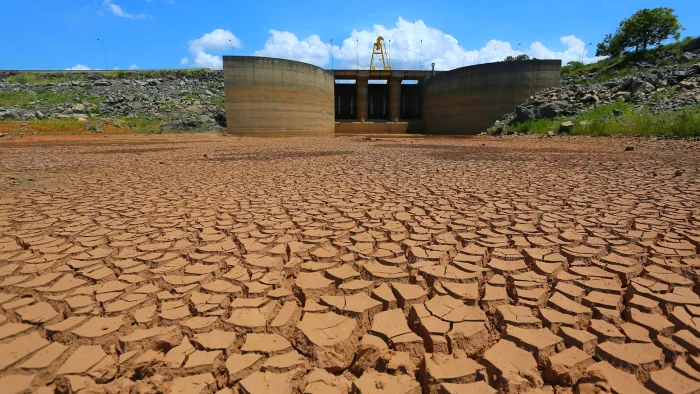
A water crisis is when the water available in a region cannot meet the uses that depend on it: public supply, industry, irrigation and power generation. In Brazil, the two biggest of recent years had an address: in 2014, the Cantareira System, which supplies Greater São Paulo, received about a quarter of the water of a normal year; in 2021, the National Water and Sanitation Agency (ANA) declared a critical scarcity situation in the Paraná basin, home to the country’s largest hydropower reservoirs. The causes repeat, and the climate tends to make the next ones more likely.
In short:
- In 2014, the average inflow to the Cantareira System was 11.3 m³/s, about a quarter of the historical average of 44.1 m³/s and the lowest in an 85-year record, according to Sabesp, São Paulo’s water utility.
- To get through the drought, Sabesp cut withdrawals from Greater São Paulo’s sources by 30% and created a bonus for those who saved water and a contingency tariff for those who exceeded their average.
- In 2021, ANA declared a critical scarcity situation in the Paraná Hydrographic Region, which had faced a rainfall deficit since October 2019. Electricity bills gained an extra tariff flag, the water scarcity flag.
- The causes combine below-average rainfall, growing demand, losses and pollution of water sources, which reduces usable water.
- ANA projects a 30% increase in water withdrawals between 2022 and 2040, and estimates that the climate could raise irrigation demand by 15% by 2040.
What is a water crisis?
It is the mismatch between the water that exists and the water that is needed, in a given place and time. It can be about quantity, when rivers and reservoirs lack volume, or quality, when the water exists but is too polluted to use. Brazil’s Water Law (Law No. 9,433/1997) already says what to do: in a scarcity situation, priority goes to human consumption and watering animals.
Having a lot of water in the country protects no one from a crisis. Brazil is rich in water, but it is badly distributed: most of it flows through the Amazon, far from where most of the population lives and where industry and irrigated agriculture are. One region can be in crisis while another has water to spare.
| Type of crisis | What happens | Example |
|---|---|---|
| Quantity scarcity | It rains less than normal and reservoirs drop | Cantareira System, 2014 and 2015 |
| Scarcity for energy | Hydropower reservoirs drop and the country switches on thermal plants | Paraná basin, 2021 |
| Quality scarcity | The water exists, but pollution prevents its use without costly treatment | Urban rivers that receive untreated sewage |
| Chronic drought | Lack of rain is structural and recurs | The semi-arid Northeast |
What caused the 2014 water crisis in São Paulo?
An unprecedented drought on top of a system already running at its limit. According to the report Crise Hídrica, Estratégia e Soluções, published by Sabesp in 2015, a zone of high atmospheric pressure blocked rain fronts in the summer of 2013 to 2014. Between October 2013 and February 2014, 444 mm of rain fell in the Cantareira region, against an average of 995 mm.
The report’s numbers show the scale of the event:
| Indicator | Value |
|---|---|
| Average inflow to the Cantareira System in 2014 | 11.3 m³/s |
| Annual average of the historical record, 1930 to 2013 | 44.1 m³/s |
| Previous worst year, 1953 | 24.6 m³/s, more than double 2014 |
| Estimated probability, up to 2013, of such a dry year | 0.49% |
| Cut in withdrawals from Greater São Paulo’s sources, January 2014 to February 2015 | 30%, from 71 to 50 m³/s |
| Cut in Cantareira output, up to March 2015 | 56%, from 33 to 14 m³/s |
To get through the crisis, Sabesp combined transfers between systems, pressure reduction in the networks, loss control and a bonus programme for those who cut consumption. After a year, it also created the contingency tariff: 40% on top of the water tariff for those who exceeded their average consumption by up to 20%, and 100% for those who exceeded it by more than 20%, including industries and businesses with firm-demand contracts. The Cantareira’s technical reserve, the so-called dead volume, also began to be pumped.
What was the 2021 water crisis?
A water and energy crisis at the same time. On 1 June 2021, ANA declared, through Resolution No. 77, a critical situation of quantitative scarcity of water resources in the Paraná Hydrographic Region, until 30 November that year. The basin had faced a rainfall deficit since October 2019 and holds the main regulating reservoirs of the national power system.
The impacts foreseen by ANA hit navigation, leisure and tourism and power generation, and the committee that monitors the power sector pointed to a risk to the country’s electricity supply. With less water at the hydropower plants, the country switched on thermal plants, which are more expensive. By decision of the exceptional rules chamber created for the crisis, the National Electric Energy Agency introduced the water scarcity tariff flag, scheduled from September 2021 to April 2022, with an estimated 6.78% increase in the average tariff for regulated consumers, according to the Ministry of Mines and Energy.
What are the causes of a water crisis?
Rarely just one. Brazilian crises combine natural and management factors:
- Below-average rainfall. Prolonged droughts, like those of 2014 and of 2019 to 2021, empty reservoirs that take years to recover.
- Growing demand. More people, more industry and more irrigation drawing water from the same basins.
- Losses. In 2024, Brazil lost 39.53% of its treated water before it reached the consumer, according to Instituto Trata Brasil. Every litre lost forces more abstraction. See water losses in Brazil.
- Pollution. Sewage discharged without treatment takes existing water out of use. In 2024, only 51.8% of the sewage generated in the country was treated. See sewage collection and treatment.
- Infrastructure at its limit. Systems with no slack, no interconnection between sources and no alternative sources turn into a crisis at the first strong drought.
Can the water crisis return?
It can, and the risk tends to grow. ANA projects a 30% increase in water withdrawals in Brazil between 2022 and 2040, with a significant share from irrigated agriculture, and estimates that climate change could raise irrigation demand by 15% by 2040, and by 20% in mechanised irrigation regions in a more critical scenario.
The Sabesp report draws a lesson that applies to everyone: up to 2013, a drought like 2014’s had an estimated probability of less than 0.5% a year, and it happened anyway. Planning only for the average year leaves the city, and the company, with no margin when the extreme year arrives.
What can companies and cities do?
Reduce their dependence on every litre before it runs short. For cities, that means cutting losses, treating sewage, interconnecting systems and diversifying sources. For companies, it means measuring consumption, eliminating waste, reusing where quality allows and having a plan for periods of restriction. In the 2014 crisis, those who already consumed little escaped the contingency tariff, and those who knew their own consumption knew where to cut.
The consequences for operations, from rationing to the electricity bill, and the water contingency plan are in water crisis and companies: 5 consequences. T&D helps a company reach the next drought spending less: SEA 360º handles implementation, without building works, with a baseline under the IPMVP protocol, electronic leak detection and repairs, and continues with ongoing management, and TDRR monitors tanks and consumption 24 hours a day.
Frequently asked questions
What is a water crisis?
It is when the water available in a region is not enough for the uses that depend on it, because of lack of rain, excess demand, losses or pollution. It can affect city supply, industry, irrigation and power generation.
What was Brazil’s worst water crisis?
Among recent ones, the 2014 and 2015 crisis in Greater São Paulo was the most serious for urban supply: the inflow to the Cantareira System in 2014 was the lowest in 85 years of records, about a quarter of the average. In 2021, the scarcity in the Paraná basin was the most serious for the power sector in recent years.
Why does water run short if Brazil has so much water?
Because it is badly distributed: most of it flows through the Amazon, far from most of the population, industry and irrigated agriculture. In the most populated regions, losses, pollution and growing demand reduce the slack in water sources.
What is dead volume?
It is the water held below the level of a reservoir’s normal intakes, which can only be withdrawn by pumping. In the 2014 crisis, Sabesp began pumping the Cantareira’s technical reserve to keep Greater São Paulo supplied.
Does a water crisis affect the electricity bill?
It does. With hydropower reservoirs low, the country switches on thermal plants, which are more expensive. In 2021, the water scarcity tariff flag was created, scheduled from September 2021 to April 2022, with an estimated 6.78% increase in the average tariff for regulated consumers.
Sources
- Sabesp. Crise Hídrica, Estratégia e Soluções da Sabesp para a Região Metropolitana de São Paulo (CHESS), April 2015, in Portuguese: Cantareira rainfall and inflows in 2014, the record since 1930, withdrawal cuts, bonus programme and contingency tariff
- ANA, Resolution No. 77 of 1 June 2021, in Portuguese: critical situation of quantitative scarcity in the Paraná Hydrographic Region
- Ministry of Mines and Energy, “CREG orders a Voluntary Demand Response Programme for captive consumers and the water scarcity tariff flag”, 31/08/2021, in Portuguese
- ANA, SNIRH Bulletin No. 1, 2022, in Portuguese: projection of withdrawals to 2040 and the effect of climate on irrigation
- Instituto Trata Brasil, 2026 Water Loss Study and 2026 Sanitation Ranking, in Portuguese
- Law No. 9,433 of 8 January 1997, Article 1, in Portuguese: priority use of water in scarcity situations
- T&D SEA 360º and TDRR